 TRACKHUB
TYRES AND PIT GARAGE
How to fit and use tyre warmers: temperatures, timing and mistakes to avoid
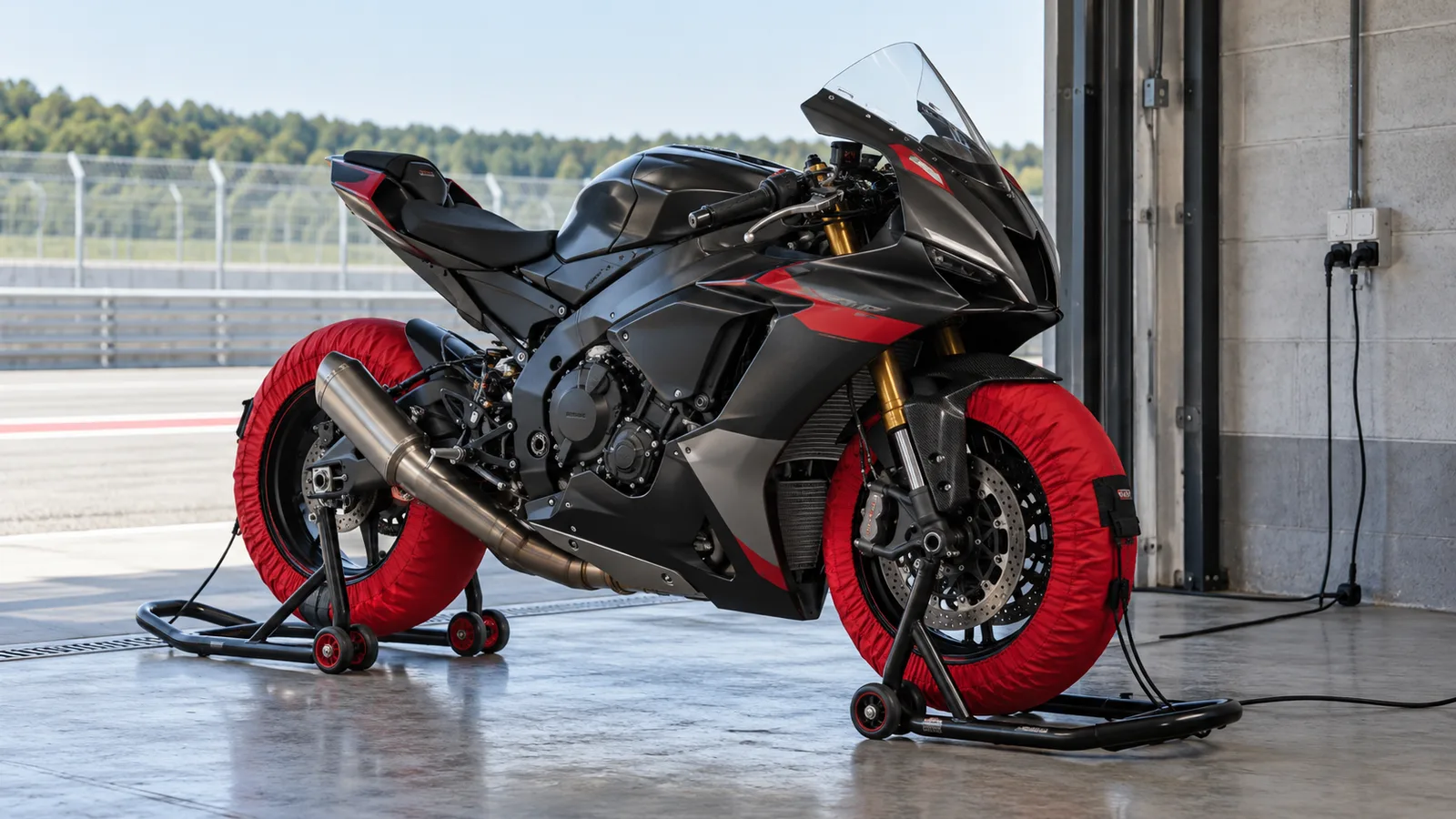
Tyre warmers do not make you faster: they let you start with the tyre already ready, so the first lap is not a wasted lap and the tyre does not struggle cold. Here you get when they are really needed, the temperatures and times given by the manufacturers, the right fitting and the mistakes that ruin tyres and heating elements.
When you really need them (and when not)
A racing tyre only works well inside a temperature window, and when cold it has neither grip nor flexibility: the risk in the first corners is real, and meanwhile you waste half a session warming it up. Dunlop says it plainly: tyre warmers are mandatory for its dry racing tyres (KR, GP PRO), highly recommended for track-day tyres such as the GP Racer D212, prohibited for road tyres such as the SportSmart Mk3 and for wets. The logic holds across brands: slicks and SC compounds want warmers, a road-legal sport tyre warms up in a lap and a half.

- Slicks and racing compounds: yes, always. It is a safety matter, not just lap time.
- Road-legal track supersport tyres (Supercorsa SP, Racetec RR K3, GP Racer): recommended; they are ready sooner and last longer if you do not abuse them cold.
- Road sport tyres (Rosso, SportSmart, Road): no. Continuous heat hardens them, and it shows when reading tyre wear.
- Wets: Dunlop allows them as optional only, at most 20 minutes at 40 °C. Many riders do not use them at all.
If you have not yet decided which tyre to fit, start with track tyres: which to choose: warmers are chosen after the tyre, never before.
Temperatures and timing: what the manufacturers say
Fixed-temperature warmers almost all sit between 80 and 90 °C: Biketek regulates at 80 °C, Capit Suprema Spina and Thermal Technology Performance at 85 °C, the fixed-temperature IRC Diamond at 90 °C. Adjustable models reach 120 °C (Capit Vision 30-120 °C, IRC digital 40-120 °C, Thermal Technology Evo Tri Zone up to 120 °C on the tread and higher on the rim). Tyres, however, want different values: Dunlop prescribes a minimum of 60 minutes at 80 °C for KR and GP PRO fronts and 60 minutes at 100 °C for most rear slicks. For Pirelli we found no public sheet with temperature and minutes; in press tests the SC tyres reach temperature after roughly 45-60 minutes under warmers.
- 60 min
- minimum under warmers before going out (Dunlop KR / GP PRO)
- 80 °C
- Dunlop racing front; 100 °C for most rear slicks
- 80-90 °C
- fixed temperature of the most common warmers
- 20 min
- maximum for wets, at 40 °C (Dunlop)
The "30 minutes" on warmer spec sheets (Capit claims a steady, even temperature in about half an hour) is the time for the warmer to reach temperature, not for the tyre to be warm through to the carcass: for that you need the tyre makers' 60 minutes. Running temperature on track is another matter again: the tyre heats itself by working, warmers exist so you do not start from zero.
Fitting: dry tyre, centred warmer, cable clear
- Clean, dry tyre. No water, no mounting lube, no stuck gravel. Moisture under the warmer turns to steam and cooks the tyre in patches; stones pierce the inner fabric.
- Bike on stands, wheels off the ground. The warmer has to wrap the whole circumference, including the part that would be on the floor.
- Centre the warmer on the tread and pull it down to the shoulders: the shoulders are the part that works at lean and the part that stays cold if the warmer is skewed. Close the velcro or straps without strangling the rim.
- Route the cable upwards and away from the disc and chain, with a gentle bend where it leaves the warmer: that is where elements break.
- Plug into a switched power strip, never under the bike. When you remove the warmers, power first, then velcro.

Sizes matter: a 180 warmer on a 200 leaves the shoulders exposed, a 200 on a 180 creases and heats unevenly. Capit lists M/L for fronts up to 120 and rears up to 180/55, M/XL for rears from 180/60 to 200-205/55; IRC runs from S (Moto3) to XXL (200/65-70). Check the brand's chart before ordering.
Power and generator: how much they draw
Warmers run on 230 V. Draw depends on size: Capit lists per single warmer 200 W (S), 300 W (M), 400 W (L), 500 W (XL), 550 W (XXL); IRC lists 900 W for the Diamond pair; for Thermal Technology's Evo Tri Zone retailers list 1450 W per pair, because it heats the rim too. A typical pair for a 1000 (front M, rear L or XL) therefore sits between 700 and 900 W at steady state, with a higher peak in the first cold minutes.

| Setup | Watts per pair | What you need |
|---|---|---|
| One bike, fixed-temperature warmers (Capit M + L) | about 700 W | A 16 A pit socket; with a generator, 2 kW or more to be safe |
| One bike, IRC Diamond digital warmers | 900 W | As above; the digital control modulates power once at temperature |
| One bike, Evo Tri Zone with rim heater | 1450 W | Dedicated socket; 3 kW generator if you share it with a compressor or fridge |
Pressures: set them hot, under the warmers
With warmers you set the pressure after heating, not cold: Dunlop prescribes setting it only after at least 60 minutes under the warmer and separates the cold value, the warmer value and the running minimum. GP Racer D212 example: front 2.1 bar cold becoming 2.3-2.4 under the warmer, rear 1.0-1.1 becoming 1.4-1.5. For Pirelli Supercorsa SC V4, according to MotorBox, you start cold at 2.0-2.2 front and 1.6-1.8 rear to reach 2.0-2.4 and 1.7-2.0 hot depending on size.
The value that counts is the one as soon as you come back in, before the tyre cools: Dunlop says to measure it right away in pit lane and notes that it stabilises after 5-8 laps. If you read more than you set under the warmer, the tyre is working hotter than you think; if you read less, it is not warming up. Values per tyre and size are in track tyre pressures. And never below the manufacturer's minimum.
The mistakes that ruin tyres and warmers
- Warmers on a wet or dirty tyre. Steam, patches, inner fabric cut by stones. Dry and brush first.
- Leaving them on for hours between sessions. The tyre does not get warmer, it gets harder. Between sessions 40-60 minutes apart you can leave them on; with a two-hour break switch off and back on an hour before.
- Taking them off too early. Take them off when they call you to pit lane, not when you get dressed. Every minute without the warmer on a standing tyre is heat lost, and the shoulder cools first.
- Riding the first lap as if the tyre were at temperature. The warmer heats the surface and part of the carcass; the tyre reaches running temperature only by working. A building lap is still needed, especially on the shoulder.
- Broken elements and thermostats that never cut out. A warmer that heats half the tyre or keeps the red light on permanently has to be stopped: check the cable at the exit, then measure several points of the tread. With a 30 °C difference between two points it needs repairing, not using.

What to buy: fixed or adjustable, and what they cost
For a track day on supersport or SC tyres, a fixed-temperature warmer at 80-85 °C does the job and costs half as much. Adjustable ones are for slicks with a rear at 100 °C as Dunlop asks, or for switching between different tyres. Indicative 2026 prices, pair for 17":
| Model | Temperature | Price per pair | Notes |
|---|---|---|---|
| Thermal Technology Easy | Fixed 85 °C (bimetallic thermostat) | €204.50 (WRS, list €274.50) | One size 180-200/55; 2-year warranty in Italy |
| Thermal Technology Performance | Fixed 85 °C | €262.65 (WRS, list €347.70) | Size L 120/70-180/55; better materials than the Easy |
| Capit Suprema Spina | Self-regulating 85 °C, no thermostat | €300 (Motostorm, list €352.58) | Sizes S-XXL, 200-550 W per warmer; 3-year warranty |
| Capit Suprema Vision | Adjustable 30-120 °C, control on the warmer | about €492-503 (Motostorm) | Discounted when checked; check the size |
| IRC Components Diamond digital | Programmable 40-120 °C | €553.39 (WRS, list €691.74) | 900 W per pair, 48-month warranty, made in Italy; cheaper fixed 90 °C version |
| Biketek Pro Series | Fixed 80 °C, red/green LED | Not verified on Italian shops | UK brand (Demon Tweeks); wattage not stated in the sheets found |
The Evo Tri Zone with rim heater is the top tier and we found no reliable Italian price to cite. For a track day, a Suprema Spina or a Performance in the right sizes will cover you for years; add an infrared thermometer and a switched power strip, both in the pit toolbox list.
Frequently asked questions
What temperature should tyre warmers be set to?
It depends on the tyre. Dunlop asks for 80 °C on racing fronts and 100 °C on most rear slicks, for at least 60 minutes. With a fixed 80-85 °C warmer you are in the right window for supersport tyres and many SC compounds; for rear slicks at 100 °C you need an adjustable warmer.
How long before the session do I switch them on?
At least an hour, as Dunlop prescribes for its racing tyres; the 30 minutes quoted by warmer makers is the warmer's time, not the tyre's. With cold air or freshly fitted tyres, allow more.
Can I leave them on all day?
Better not. Between closely spaced sessions yes, but hours of continuous heat harden the compound and wear out the elements. In long breaks switch off and switch back on an hour before you go out.
Do I need warmers with Supercorsa SP or Rosso tyres?
With Supercorsa SP, and road-legal track supersport tyres in general, they are recommended: ready sooner and longer lasting. With Rosso and road sport tyres, no: they warm up in a lap and continuous heat ruins them.
What generator do I need for a pair of warmers?
A typical pair draws 700-900 W at steady state (Capit M+L about 700 W, IRC Diamond 900 W), more in the first minutes. A 2 kW generator is enough for one bike with headroom; with two bikes or a compressor plugged in, move to 3 kW.
Do I set the pressure before or after the warmers?
After, with the tyre at temperature: Dunlop says to set it only after at least 60 minutes under the warmer. Then check the value as soon as you come back in and adjust from there.