 TRACKHUB
TRACK PRESSURES
Track tyre pressures: cold and hot
Pressure is the cheapest and most neglected adjustment on the whole bike. A couple of tenths of a bar change grip, wear and feel more than many suspension clicks. Here are the figures manufacturers publish for the tyres most used on track days, how to measure them and how to read the rise during a session.
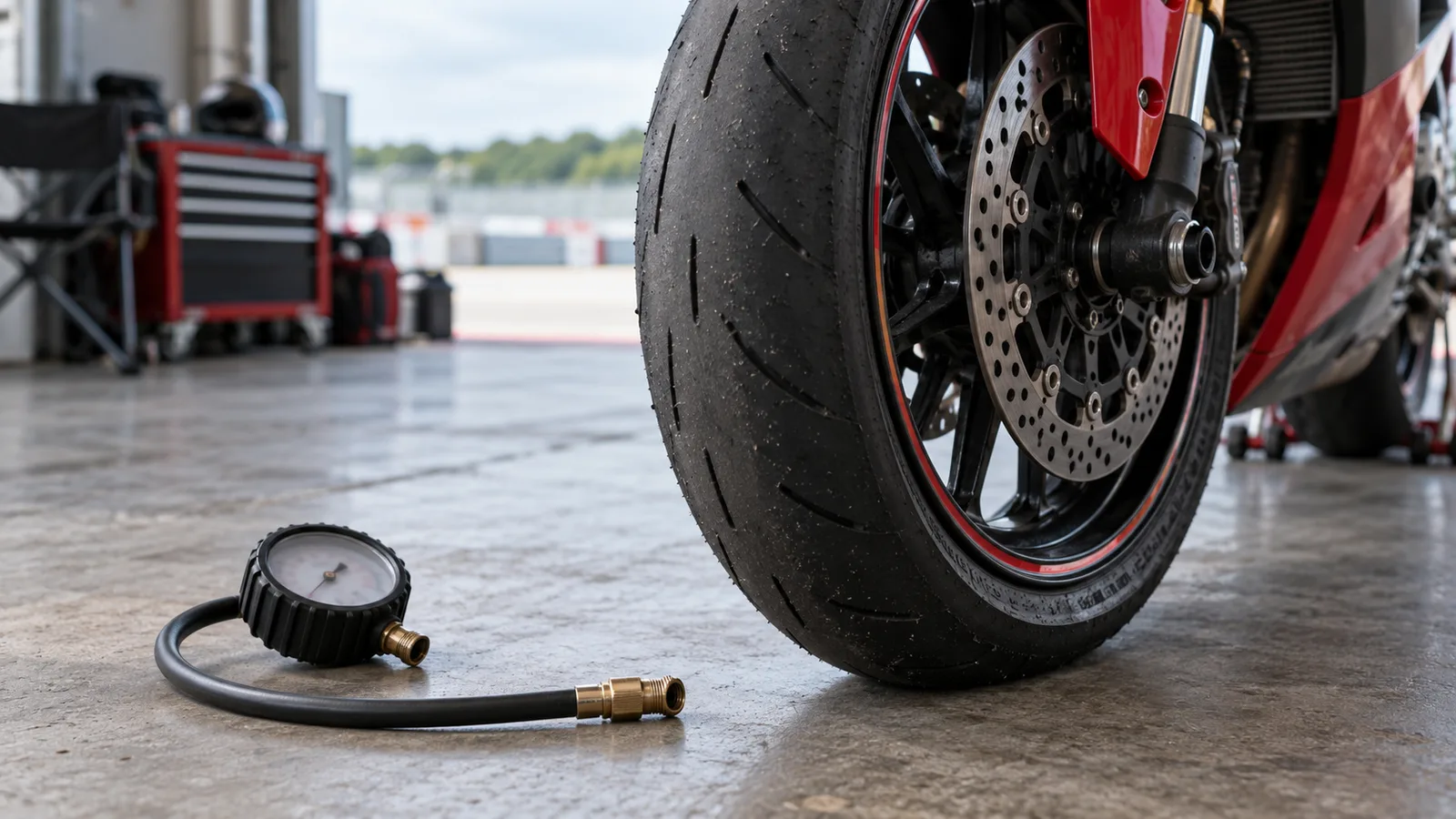
Why track pressures are lower than road pressures
On the road the bike manufacturer specifies high pressures (often 2.5 bar front and 2.9 rear) for tyre life, fuel economy and two-up loads. On track the tyre works at much higher temperatures with continuous lateral loads: a lower pressure lets the carcass flex more, widens the contact patch and helps the tyre reach and hold temperature. Too low, though, the carcass moves too much, the tyre overheats and the bike becomes vague. The right window is narrow and different for every tyre: that is why you start from the tyre maker's figure, not the bike's.

The figures published by manufacturers
Below you will find only figures published by the manufacturers or reported by the press quoting their technicians. They are starting ranges: they vary with size, bike, asphalt temperature and your pace. Where the maker distinguishes between "cold" and "hot" we report it; where it does not, we say so.

| Tyre | Cold front / rear | Hot front / rear | Notes |
|---|---|---|---|
| Pirelli Diablo Supercorsa SP V4 | Not stated in the sources found | 2.3 / 2.1 | Hot track figure reported by MotorBox; a retailer lists 33/30 psi hot |
| Pirelli Diablo Supercorsa SC V4 | 2.0-2.2 / 1.6-1.8 | 2.0-2.4 / 1.7-2.0 | Depends on size (MotorBox) |
| Pirelli Diablo Rosso Corsa II | About 2.1 / 1.8 (31 / 26 psi) | Not specified | Track figures given by Pirelli staff at the launch (Ultimate Motorcycling); the source does not say cold or hot |
| Dunlop GP Racer D212 | 2.1 / 1.0-1.1 | 2.4-2.5 / 1.5-1.7 | Dunlop table. After warmers: 2.3-2.4 / 1.4-1.5. Minimum running: 2.4 / 1.4 |
| Michelin Power Cup 2 | 2.1 / 1.5 (minimum) | 2.4 / 1.7 (target) | Michelin table; hot after 6 laps |
| Metzeler Racetec RR | 2.0-2.2 / 1.6-1.8 (29-32 / 23-26 psi) | After warmers 2.1-2.4 / 1.7-1.9 | Listed as Metzeler recommendations by retailers; not verified on Metzeler's site |
With and without warmers
Michelin is explicit: cold pressure is set with tyre and rim at ambient temperature, before fitting the warmers, and must never be corrected with the warmers on because the reading is inflated by heat. Warmers bring the tyre to temperature sooner, but never justify a lower starting pressure. Dunlop instead gives two columns: a "cold" figure for riders without warmers and an "after warmers" figure (60 minutes at 80 °C front, 100 °C rear for the D212) to read as soon as you remove them. If you use warmers, follow the right column for your brand. Times and temperatures are in the tyre warmers guide.
How to measure: the gauge and the right moment
- One gauge, always the same one. Two instruments can differ by 0.1-0.2 bar: it does not matter which is "right", it matters that your numbers are comparable with each other. A good digital or dial gauge with a fine scale is the best money you spend in the pit.
- Cold means ambient temperature, in the shade, before the first session or before the warmers go on. A tyre left in the July sun is not cold.
- Hot means the moment you return to the pit, before the tyre starts cooling. Dunlop says "immediately after entering the pit area".
- Measure always the same way and write everything down, with air temperature and session type: only then do the numbers mean something from one track day to the next.

How pressure rises during a session
The air inside the tyre heats up and pressure rises: how much depends on tyre, pace and track. Dunlop says running pressures stabilise after about 5-8 laps; Michelin takes its hot reading after 6 laps. Two rules follow. First: do not bleed air mid-session based on a hot reading, as Michelin warns; bleeding hot would put you below the cold minimum for the next session. Second: the gap between cold and hot is information. If the rear climbs much more than expected, you are working the tyre harder than it should (low starting pressure, a setup that tears it, abrupt throttle). If it barely climbs, you are not getting it to temperature: slow pace, high pressure or a cold day. Abnormal wear usually confirms the diagnosis.

- 5-8 laps
- to stabilise running pressure (Dunlop)
- 70-90 °C
- warmers for at least an hour before the first session (Michelin)
- 1 gauge
- always the same one, all season
Road and track: the table to keep in the van
| Situation | Reference | Example |
|---|---|---|
| Road, normal use | Bike owner's manual | Pirelli quotes about 2.5 / 2.4 bar (36 / 35 psi) for commuting on the Rosso Corsa II |
| Road, spirited riding | Owner's manual or tyre maker | Pirelli for the Rosso Corsa II: about 2.4 / 2.3 bar (35 / 33 psi) |
| Track | Tyre maker's table | See the table above; always lower than on the road |
| Back on the road after the track | Restore the manual's cold pressure | Michelin requires it explicitly |
Pressure and wear symptoms
- Too high: small contact patch, tyre that never reaches temperature, glazed surface or half-moon tears (cold tear), little confidence on turn-in.
- Too low: overheating tyre, surface rolling into waves (hot tear), bike weaving on the straight and squatting on exit.
- Right: matte, even surface, tyre edge worn progressively, hot pressure inside the maker's window.
Frequently asked questions
What pressure for Pirelli Supercorsa SP on track?
The sources found report about 2.3 bar front and 2.1 rear hot for the SP V4 on track. For the SC V4 Pirelli, via MotorBox, lists 2.0-2.2 / 1.6-1.8 bar cold. Check your bike's size on Pirelli's sheet.
Diablo Rosso Corsa 2 pressure on track?
At the launch, Pirelli staff quoted 31 psi front and 26 rear (about 2.1 / 1.8 bar) for track use, without saying whether cold or hot. Start there, measure hot and correct cautiously.
Dunlop D212 GP Racer: what pressures?
Dunlop publishes the table: front 2.1 bar cold, 2.4-2.5 running; rear 1.0-1.1 cold, 1.5-1.7 running. After 60 minutes in warmers: 2.3-2.4 front and 1.4-1.5 rear.
Do you measure pressure cold or hot?
Both, for different purposes: cold to set the starting value (before the warmers), hot the moment you come in to check you are inside the maker's window. Do not bleed air hot based on that reading.
Which gauge for motorcycle tyres?
A good-quality one with a fine scale (0.05 bar or 0.5 psi), digital or dial, with an angled chuck to reach the valve between the spokes. And above all always the same one: repeatability is worth more than absolute accuracy.
Do I need to re-inflate for the road after the track?
Yes. Track pressures are too low for the road: an overworked carcass, rapid wear and vague behaviour when cold. Restore the owner's manual values, cold.