 TRACKHUB
FROM ROAD TO TRACK
How to prepare a road bike for the track
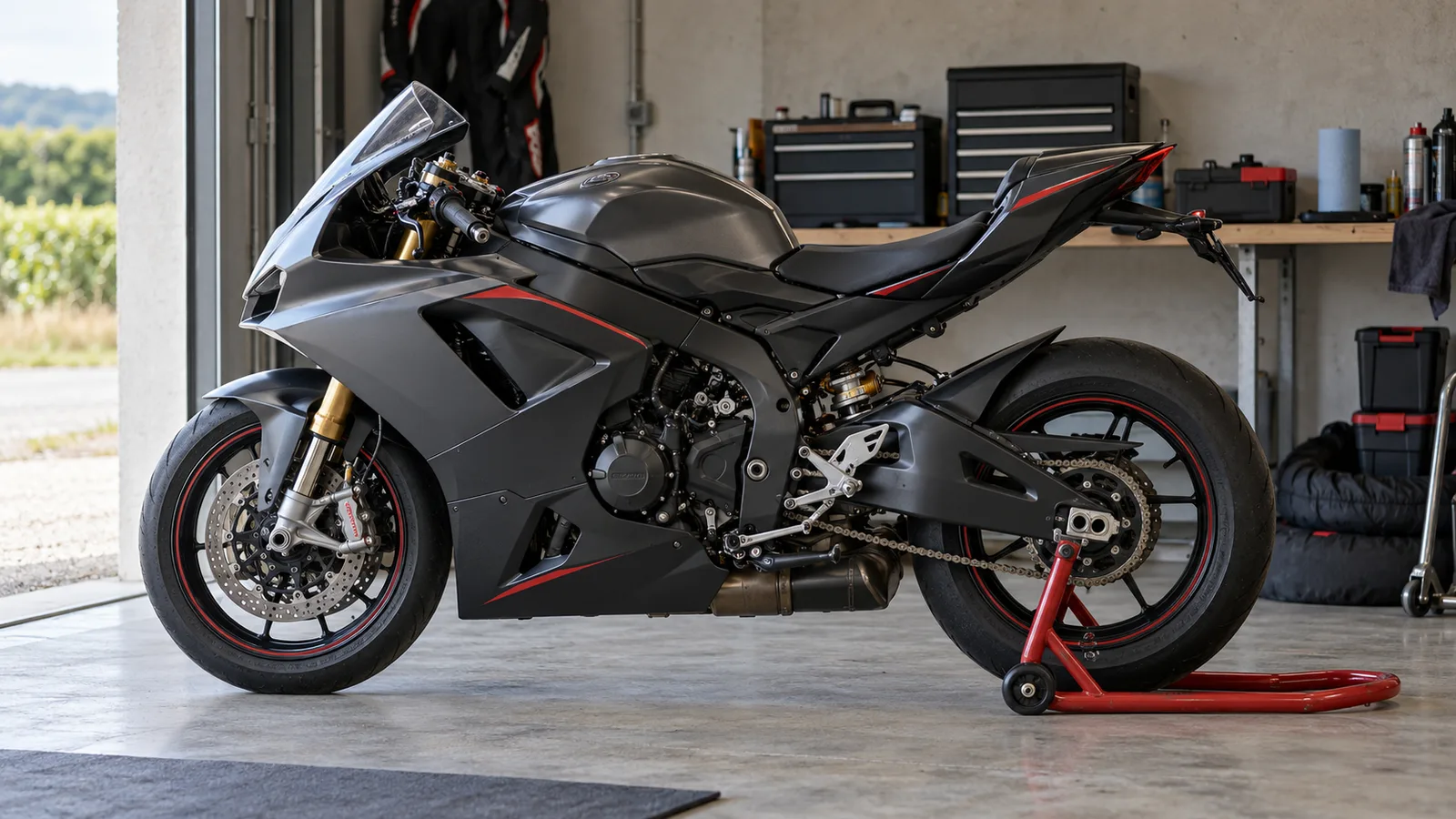
You do not need a race bike to go on track: you need a road bike put in a condition where it will not hurt you or anyone else. Here is what organisers in Italy usually ask for, why they ask, what is worth doing even if nobody checks, and how to put everything back for the road.
What organisers ask for
There is no single rulebook for open practice days in Italy: every circuit and every organiser has its own, and checks range from a glance in the pit lane to a technical inspection with a sound meter. The requirements that come up almost everywhere are these. Read your event's rules anyway: they are the only source that counts on the day.

- Mirrors removed or taped, number plate removed or covered.
- Headlight, indicators and brake light taped (or removed): in a crash the glass does not end up on the track, and a lit lamp does not distract whoever is behind you.
- No glycol in the radiator where required: distilled water with an anti-corrosion additive.
- Noise within the circuit limit, measured at a fixed rpm.
- Side stand removed or secured; some organisers require safety wire on caps and plugs.
- Tyres in good condition, effective brakes, no visible leaks.
Coolant: why water and not glycol
Stock coolant is a mix of water and glycol. If a hose fails or the bike goes down, glycol ends up on the asphalt and makes it as slippery as oil, except that it does not evaporate and does not wash away easily: the track stays dangerous for everyone until it is cleaned. That is why many organisers, in Italy and abroad, ban glycol and require distilled water plus an anti-corrosion and pump-lubricating additive (products such as Water Wetter or Motul MoCool, at the maker's dosage). Some accept glycol-free "racing" coolants: if in doubt, ask the organiser before buying.

- With the engine cold, drain the system at the pump drain plug (or the lower radiator hose) and empty the expansion tank.
- Fill with distilled water, run the engine until the thermostat opens, drain again: this removes almost all the residual glycol.
- Fill with distilled water and additive, bleed the air (radiator cap off, engine idling, squeeze the hoses) and top up the tank.
- Mark on the bike or in the logbook that it runs water: at season end, before frost, you must put antifreeze back in.
Safety wire
Safety wire (0.8 mm steel wire passed through a hole in the cap and anchored to a fixed point) stops a cap unscrewing under vibration and dumping oil on the track. In racing it is mandatory; on open practice days it depends on the organiser, but it is one of the few modifications that costs a few euros and can prevent a crash for you or whoever is behind you. The classic points:

- Engine oil filler cap.
- Oil drain plug (sump).
- Oil filter (with a clamp or wire linking it to the crankcase).
- Radiator cap.
- Where applicable, axles and brake calipers with drilled nuts.
Noise limits
Noise is the reason many Italian circuits face closures and reduced hours, and checks are increasingly frequent. Since 1 September 2018 Mugello does not admit bikes exceeding the noise limits of their homologation or their federation's class rules, including amateur open practice days, with random checks at a fixed rpm and a 3 dB tolerance. Limits vary by circuit and measuring method: in the sources found they range from the 95 dB(A) for road bikes and 98 dB(A) for competition bikes quoted years ago by Franciacorta (measured 50 cm from the exhaust, at 45°, at about three quarters of maximum rpm), to the 102 dB at 5,500 rpm of the CIV Superbike rules that Ducati quotes for its dB killers. An aftermarket exhaust without a dB killer on a 1000 easily exceeds these figures: a dB killer costs less than a lost session.

Tyres, brakes, chain
- Tyres: a sport road tyre or a road-legal supersport in a hard compound is fine to start; at track pressures, not road ones. The options are in the track tyres guide.
- Pads: stock pads are enough for the first track days if they have at least half their thickness; a track sintered compound improves heat resistance. Fresh brake fluid.
- Chain: tensioned per the manual, clean and lubed; a slack chain on track jumps or whips the casing.
- Levers: a brake lever that snaps in a minor fall ends your day. Lever guards are mandatory in many race series and sensible everywhere.
Protection: sliders, frame guards, fairings
Frame sliders and engine case guards are the investment with the best ratio of cost to damage avoided: a low-speed slide with sliders is a scratched fairing, without them it can be a holed casing with oil on the track. Aluminium or composite case covers are required in racing and increasingly recommended. Fibreglass race fairings are optional: they cost money, but they save the original bodywork (far more expensive) and can be repaired with resin. If the bike goes back on the road, many riders fit fibreglass only for the track and keep the stock fairings in the garage.
Check before you go out
- Cold pressures with your own gauge, before the warmers.
- Oil level and no leaks under the bike after it has stood still.
- Brake lever with normal travel, pads inspected, discs clean.
- Tape on lights and mirrors intact, plate off.
- No loose objects: caps, keys, phone in the suit pocket.
- GPS lap timer on and with satellite fix, if you use one.
The printable track day checklist puts all of this on one page to hang in the pit.
What to restore before going back on the road
| Item | On track | On the road |
|---|---|---|
| Mirrors, plate, lights | Removed or taped | Refitted and working: without them you are liable to a fine |
| Tyre pressures | Tyre maker's table | Owner's manual values, cold |
| Coolant | Distilled water + additive | Fine until frost; antifreeze before winter |
| Exhaust | With dB killer for the circuit limit | Homologated, otherwise it is a ticket at the first stop |
| Side stand | Removed or secured | Refitted, with the switch connected |
Once prepared, the bike needs looking after: track-hour intervals and the checklist after every day are in the guide to routine maintenance for a track bike.
Frequently asked questions
Do I have to remove the coolant to go on track?
It depends on the organiser's rules: many ban glycol because it is slippery and hard to clean up. Distilled water with an anti-corrosion additive is accepted almost everywhere. Check your event's rules.
Can I go on track with an aftermarket exhaust?
Yes if it is within the circuit's noise limit, measured at a fixed rpm. Without a dB killer a sportbike easily exceeds the limits; with it, it usually complies. If a check finds you over the limit you do not go out.
Do I need race fairings?
No, they are optional. You do need frame sliders and case guards, which prevent the expensive damage. Fibreglass fairings make sense for frequent track riders who want to preserve the originals.
What tape do I use for lights and mirrors?
Duct tape or bodyshop masking tape that leaves no residue in the heat. Cover the whole glass surface, not just a strip: the point is to hold the fragments together in a crash.
Is safety wire mandatory on open practice days?
Not always: in racing yes, on open practice days it depends on the organiser. It costs a few euros and protects everyone from an oil spill on track: do it anyway, at least on the oil filler, drain plug and filter.